
Capability Building Must Drive Performance
Turning Enablement into Performance

Corporate Learning and Development (L&D) is often managed through participation rates, learning hours, and completion rates. These metrics show reach and usage. For executive teams, however, they do not adequately answer the key question: How does capability building contribute to the performance and competitiveness of the business? Learning creates value only when business performance improves.
Effective learning management starts with business objectives, not the course catalog. Once the actions required to achieve those objectives are clear, companies can determine which capabilities they need to build and how to measure success. Learning then becomes a management tool rather than an HR topic.
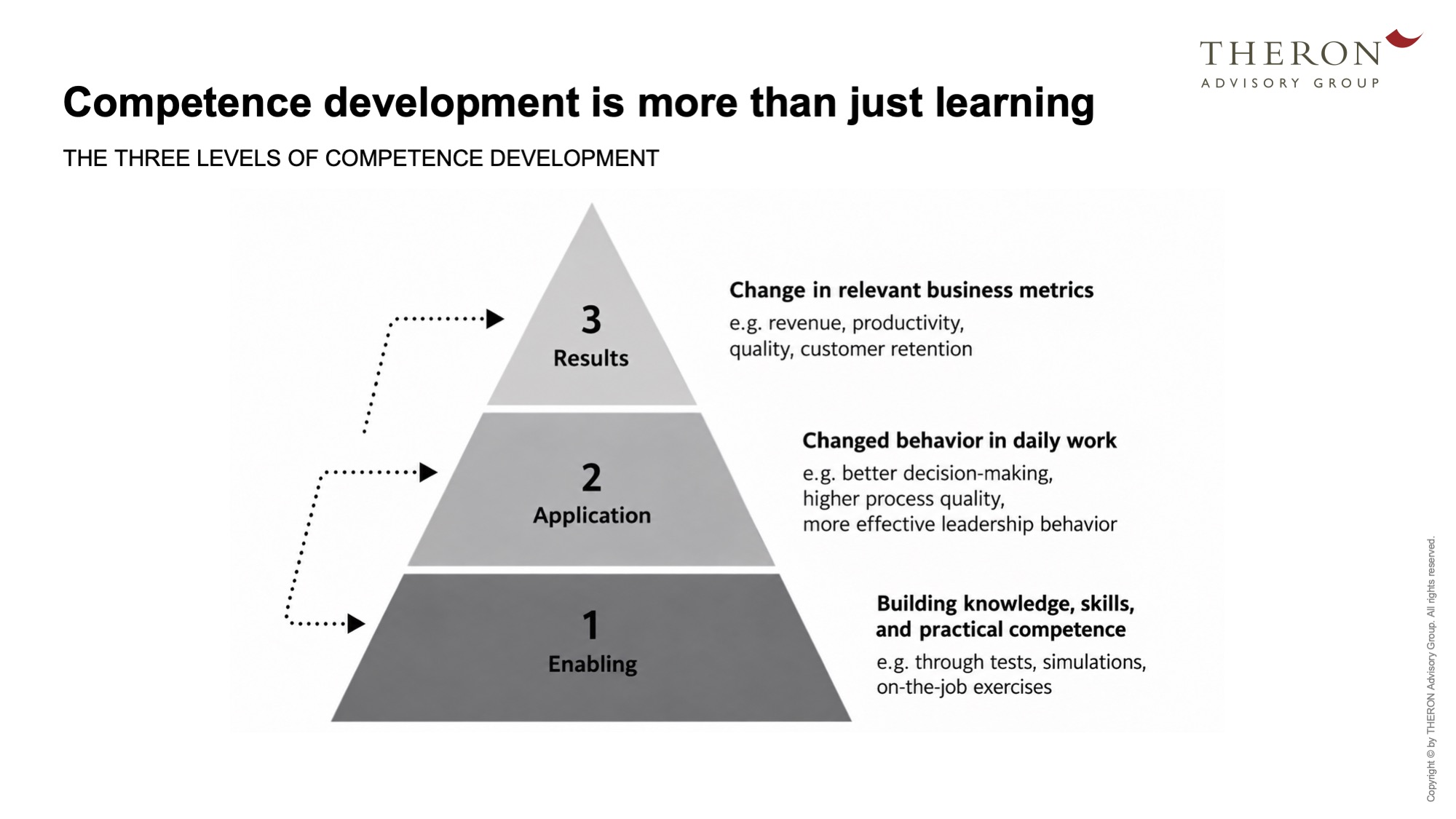
The Three Levels of Capability Development
The impact model has three levels, based on the Talent Development Reporting Principles:
- Capability. This shows whether employees have built relevant knowledge, skills, and the ability to act effectively. Suitable measures include work samples, simulations, case exercises, and structured observations.
- Application. This shows whether employees apply what they have learned in their day-to-day work. Evidence may include changed work practices, better decisions, higher process quality, or more effective leadership behavior.
- Business outcomes. This shows whether relevant business metrics improve, such as productivity, error rates, cycle times, customer satisfaction, revenue, or internal mobility.
 © Theron Advisory Group
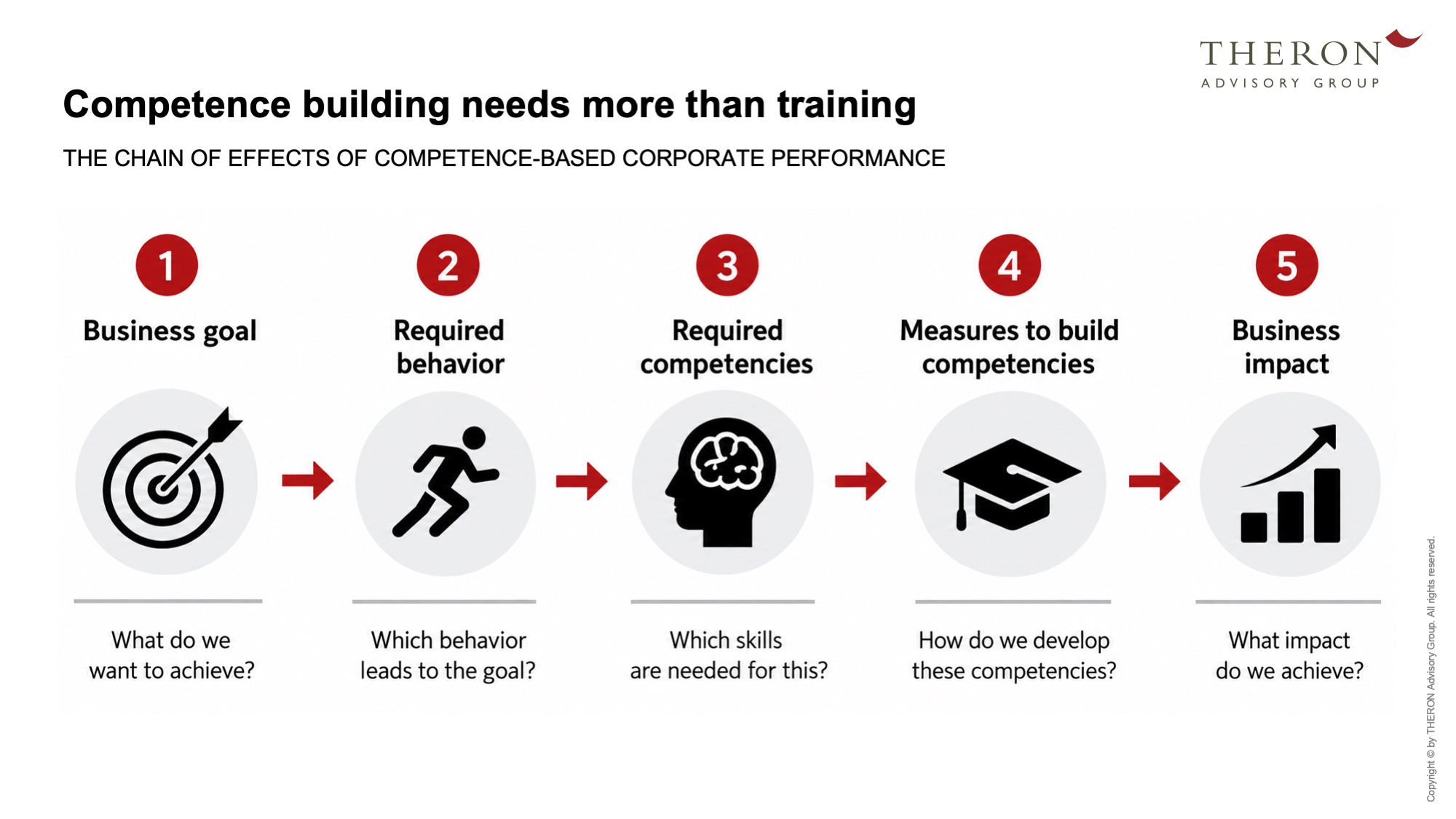
Together, these levels form a continuous impact chain:
- Business objective
- Required actions
- Required capabilities
- Capability-building measures
- Business impact
Only when this chain is traceable can a company determine whether an investment in capability building is achieving its purpose.
 © Theron Advisory Group
Learning transfer - the application of learning in day-to-day work - connects capability with business outcomes. It does not happen automatically. Leaders must reinforce new behaviors, work processes must provide sufficient room to apply them, and employees need opportunities to use new approaches under real-world conditions.
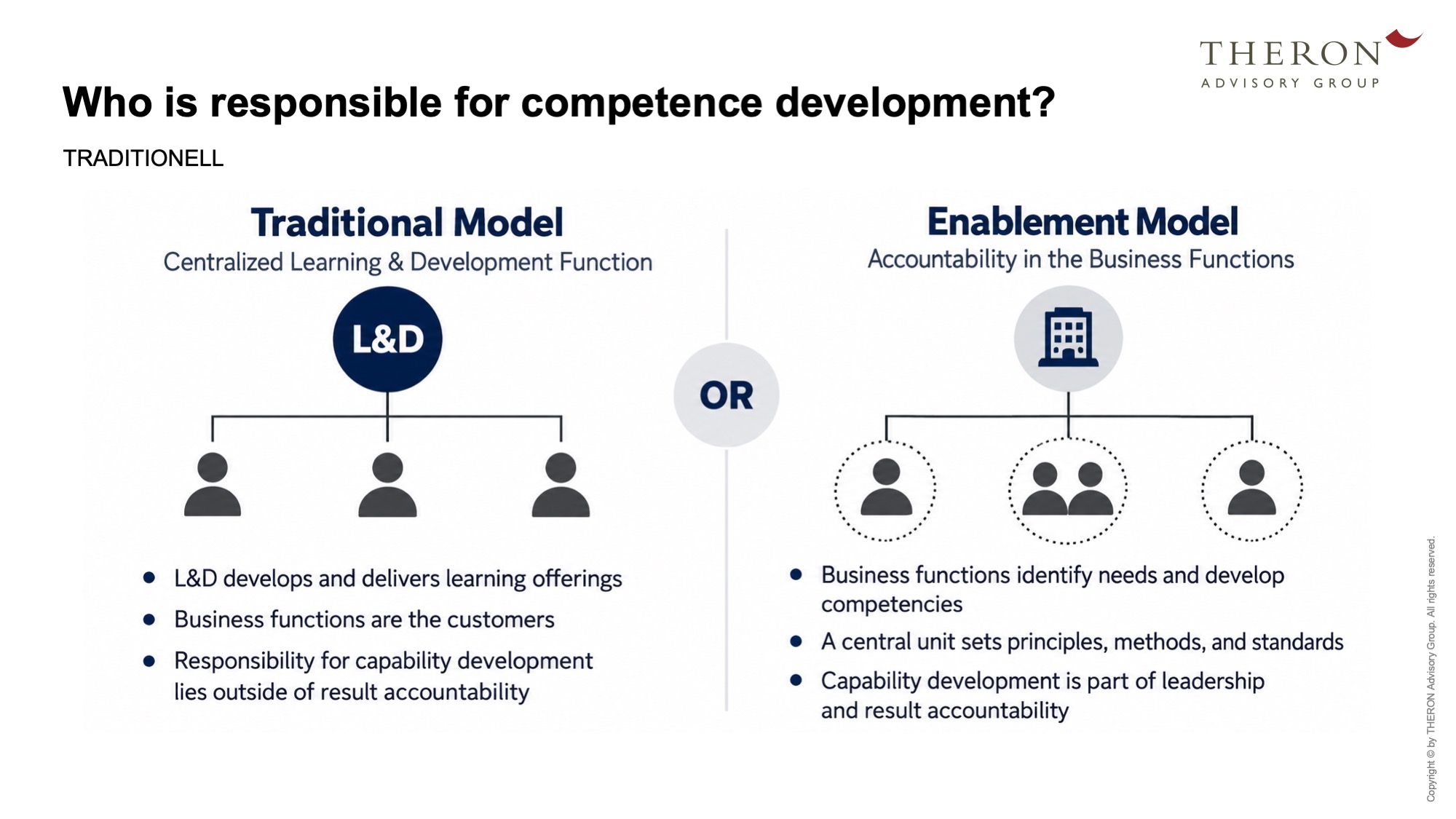
A central function should therefore focus less on providing and administering learning offerings and more on establishing shared principles, methods, and quality standards for effective enablement. Its role is to create the organizational framework for capability building.
 © Theron Advisory Group
Regardless of the organizational model, three capabilities are essential:
- A robust understanding of business processes. This allows the organization to distinguish capability gaps from performance issues caused by processes, structures, or incentive systems.
- The methodological expertise to make impact visible. This requires clear target metrics, appropriate benchmarks, and a disciplined separation of capability, behavior, and outcome data.
- The ability to discuss business performance with leaders.
Success is not determined by the number of training programs delivered. It depends on whether people change how they work and whether business outcomes improve as a result.
The Prerequisites
Enablement must become part of enterprise management. Executive leadership should ensure that business objectives, capability building, and impact measurement follow one integrated logic rather than operating as separate management systems.
This requires:
- a consistent framework for business objectives, target groups, and impact;
- shared metrics across business units and support functions;
- clear accountability for data collection and analysis;
- regular decisions to continue, adapt, or discontinue initiatives; and
- a tiered measurement effort aligned with strategic importance and investment level.
Not every initiative requires a full business case. Mandatory compliance training should be assessed differently from leadership programs or technology rollouts. The depth and effort of impact measurement should match the economic risk and investment involved.
Executive leadership determines the strategy and how closely capability building is linked to business, organizational, and people strategy. The strategy defines the capabilities required for future competitiveness. Capability building therefore becomes an investment decision rather than an administrative task.
What Should Leaders Ask?
Four management questions are central:
- Which capabilities will the company need in the coming years, and at what level of proficiency?
- Which of these capabilities are critical to achieving business objectives?
- Which capabilities should be built internally, and which should be sourced externally?
- How will executive leadership know that capability building is succeeding?
These questions shift the discussion from learning budgets and
participation rates to the company's future readiness. They reveal capability gaps, clarify investment priorities, and show which initiatives actually create impact.
Business Value Without False Precision
For larger investments, capability building should follow the same economic standards as other business decisions. For example, a company may want to accelerate the creation and translation of digital learning content with Artificial Intelligence (AI)-enabled tools. The business case must consider more than software licensing costs. It should also include existing contracts, implementation effort, employee training, governance requirements, and organizational changes.
Economic value does not come from simple cost comparisons. It requires transparent assumptions, a complete view of costs, and verifiable business impact.
Strategic Takeaway
Executive teams can turn capability building into an effective management tool in three steps:
- For every major initiative, define the business objective and the desired observable behavior.
- Set one metric each for capability, application, and business outcomes.
- After an agreed period, decide with the responsible leaders whether to scale, adapt, or discontinue the initiative.
This turns capability building from a cost item into an instrument of enterprise management. The key question is whether the organization systematically builds the capabilities required for future competitiveness---and whether those capabilities translate into better decisions, stronger processes, and measurable business results.
Back to Publications