
Pay Attention to Changes in Customer Behavior
Lead your business with ambidexterity

Companies invest billions in innovation, yet the returns often fall short of expectations. The reason is rarely a lack of technology or operational efficiency. Instead, it is the systematic neglect of one critical dimension: customer behavior. A structured portfolio approach shows how executives and senior leaders can position their organizations for sustainable success.
The Innovation Spending Paradox
More than two-thirds of all innovation initiatives fail to create measurable economic value. This is not a coincidence. It is the result of a structural management bias that has become deeply embedded in organizations over decades.
Since the 1970s, companies have optimized innovation along two primary dimensions: efficiency and capabilities. Efficiency is the ability to achieve the same outcomes with fewer resources. Capabilities refer to new technological or functional characteristics of a product or process. Both dimensions are well understood, can be taught, and are relatively easy to manage.
What they fail to capture is the third—and most important—dimension.
The Overlooked Dimension
Customer behavior changes. That may sound obvious, but it has profound strategic implications.
Most planning processes implicitly assume that tomorrow’s demand will resemble today’s demand. Statistically, this is a risky assumption. Traditional market research measures customer preferences, but it rarely detects behavioral discontinuities. Such shifts emerge with little warning and often hit organizations with highly developed planning cultures the hardest.
When customers behave differently than expected, investments in efficiency and capabilities quickly become sunk costs with little or no return. When customer behavior evolves faster than the organization itself—including its values, decision-making patterns, and established routines—companies soon face both a performance crisis and a crisis of strategic relevance.
Startups rarely outperform established competitors because they possess superior technology. They win because they recognize changing behavioral patterns earlier—or actively shape them.
Incremental or Exploratory? That Is the Wrong Question
Executive teams often debate whether their organizations should pursue incremental or exploratory innovation. This is the wrong question.
Both approaches are essential because they address fundamentally different risk-return profiles. In management research and practice, this capability is known as organizational ambidexterity: the ability to excel in today’s business while simultaneously reinventing the company for tomorrow. Achieving this requires fundamentally different management systems.
- Incremental innovation is a relatively predictable investment. It serves existing customers, improves established offerings, and follows existing demand. Its risk profile is manageable, and its business case is straightforward.
- Exploratory innovation, by contrast, targets emerging or changing behavioral patterns. It requires different leadership approaches, different performance metrics, and significantly greater tolerance for uncertainty and failure.
This creates a fundamental management challenge: many organizations apply incremental management practices to exploratory initiatives. As a result, they systematically eliminate precisely those projects with the greatest long-term growth potential. Formal innovation processes often excel at identifying uncertainty as risk—and then removing it.
The Portfolio Principle as a Management Framework
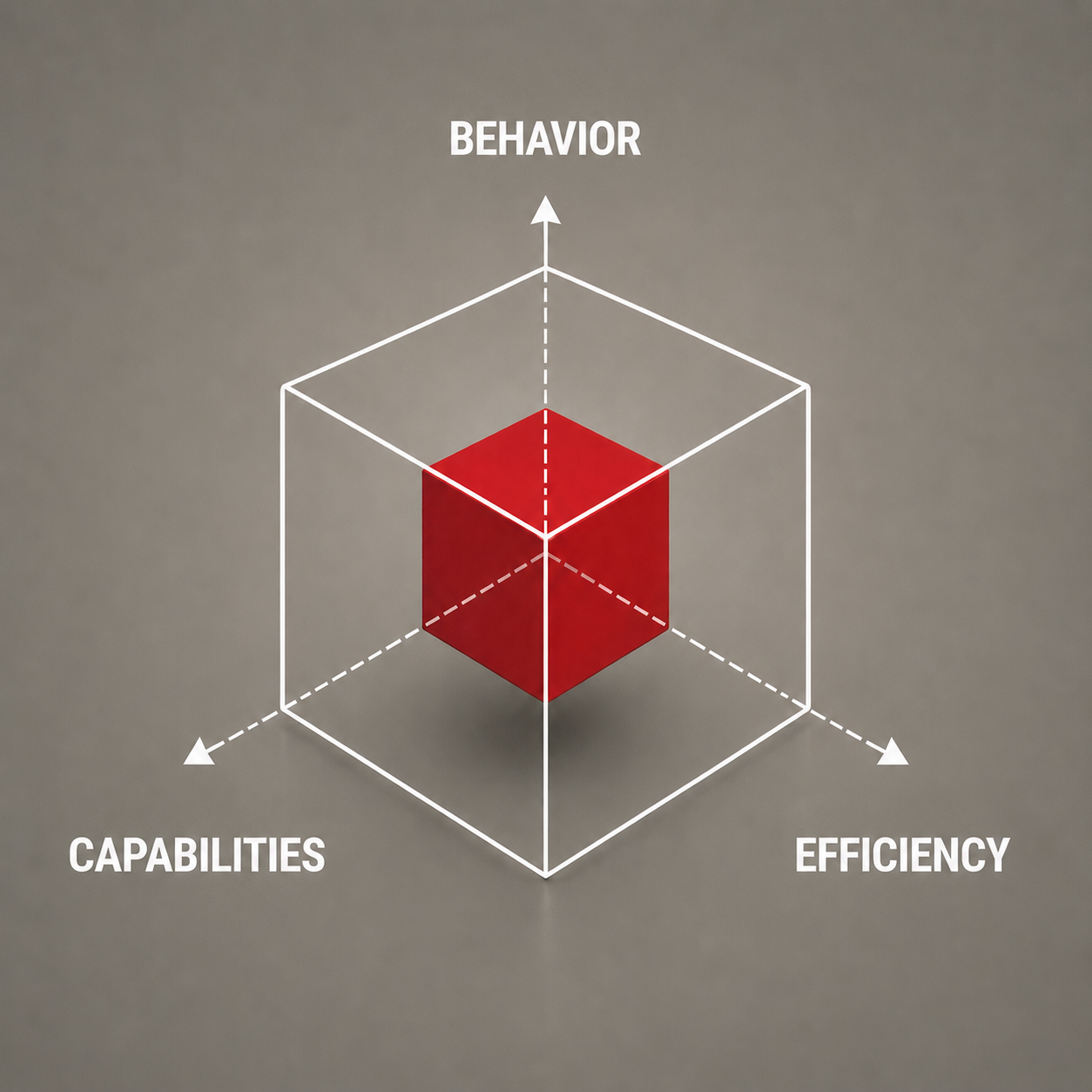
A structured innovation portfolio resolves this problem by evaluating initiatives across three dimensions:
- Efficiency
- Capabilities
- Customer behavior
Customer behavior is the defining dimension. It separates the innovation portfolio into two distinct management domains.
- The incremental domain includes product improvements, productivity enhancements, and sustaining innovations. Customer behavior remains largely stable, allowing traditional planning and development processes to perform effectively.
- The exploratory domain includes process innovations that require significant behavioral change, expansion into new markets with unfamiliar customer contexts, and initiatives that fundamentally reshape competitive dynamics.
The iPhone ecosystem, biotechnology-based insulin production, and the emergence of online banking all illustrate this type of innovation. They did not merely improve products—they fundamentally changed the behavior of entire customer populations.
What Leaders Should Do Now
Senior leaders should recognize customer behavior as a strategic management variable.
- Treat customer behavior as a core business metric. Customer behavior is not a “soft” factor. It is the single most important driver of revenue—and ultimately of enterprise value. Organizations that fail to analyze it systematically are navigating without reliable guidance.
- Assess your innovation portfolio objectively. Many companies believe they are pursuing exploratory innovation when, in reality, nearly all of their investments remain incremental. Evaluating the portfolio across efficiency, capabilities, and customer behavior creates transparency and reveals strategic gaps.
- Align governance and resource allocation with the type of innovation. Managing exploratory initiatives with traditional milestone reviews and near-term profitability requirements is a structural mistake. High-potential opportunities are often eliminated before they have a chance to mature. Startups enjoy an advantage here—not because they possess greater resources, but because they operate with greater managerial flexibility.
- Recognize transition points early. Most organizations realize too late when incremental improvements are no longer sufficient. This dilemma affects successful companies in particular because their existing business commands management attention and reinforces current priorities.
Conclusion
Innovation rarely fails because of technology or operational efficiency. It fails because organizations do not recognize emerging behavioral change early enough—or fail to adapt decisively once they do.
Companies that manage innovation portfolios without explicitly incorporating customer behavior optimize the wrong variable. Markets eventually penalize this mistake. The consequences may not appear immediately, but they become increasingly evident over the medium and long term.
If you would like to structure and manage your innovation portfolio across these three dimensions, Theron can help. We work directly with your leadership and innovation teams—from portfolio assessment through implementation—to build an innovation system designed for long-term growth.
Back to Publications